
AeroNav: Airline-grade
dispatch, for the
rest of aviation.
AeroNav, by AeroLayer, delivers 4D flight planning from OEM performance data, Australian alternate assessment, and runway performance, connected in a single dispatch chain. The precision the majors rely on, for turboprop, piston and regional-jet operators.
The dispatch surface, live.
One integrated chain, from schedule to signed-off OFP.
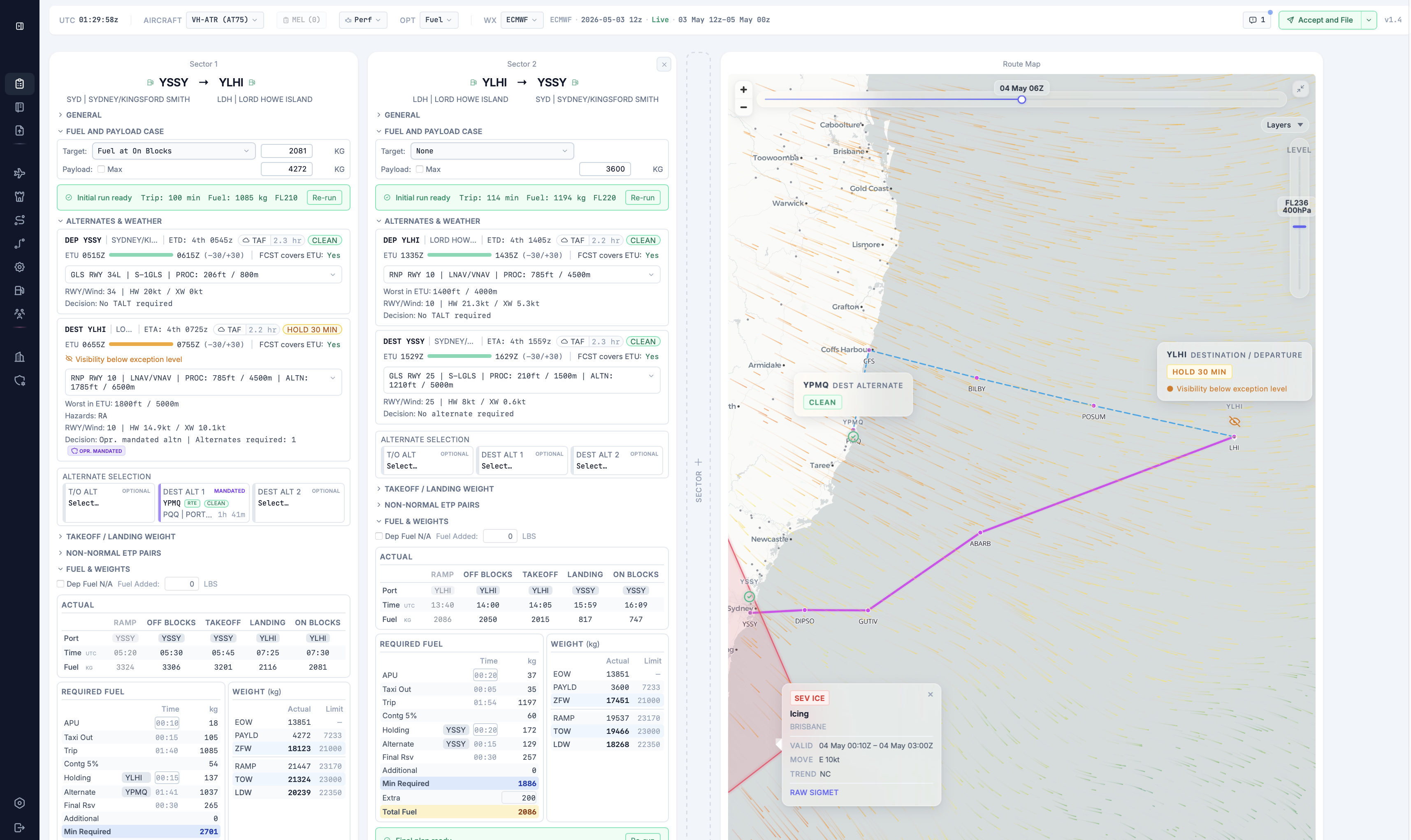
AeroNav connects schedule, weather, fuel, payload, alternates, runway performance and OFP release in one workflow, so operational changes flow through the plan before release.
OFP Flight Planning
Build the route, fuel policy and payload assumptions from the same workflow.
Weather Assessment
Assess TAFs, METARs and forecast changes against the flight, not in isolation.
Runway Performance
Check take-off and landing limits with their payload impact before release.
Six stages from schedule
to signed-off OFP.
Every sector flows through a six stage dispatch chain. A weather change automatically cascades through alternates, runway limits, and fuel. The entire chain re-runs in seconds.
Sectors Loaded
Flights populated from the schedule
Weather Assessed
TAFs parsed at departure & destination
Alternates Resolved
Candidates planned & weather-checked
Runway Analysed
RTOW & landing for actual conditions
Fuel Finalised
Reserves & discretionary determined
OFP Released
Final OFP released, ATS flight plan filed, and electronic navlog sent to crew
Sectors Loaded
Flights populated from the schedule
Weather Assessed
TAFs parsed at departure & destination
Alternates Resolved
Candidates planned & weather-checked
Runway Analysed
RTOW & landing for actual conditions
Fuel Finalised
Reserves & discretionary determined
OFP Released
Final OFP released, ATS flight plan filed, and electronic navlog sent to crew
Every stage re-runs automatically when inputs change. A weather shift cascades through the entire chain in seconds.
Routine flights plan themselves.
You handle the exceptions.
AeroNav prepares upcoming sectors automatically, then refreshes weather, fuel, alternates and performance as departure approaches. When something changes, the exception is surfaced clearly for review.
Flights are prebuilt
Upcoming sectors are prepared ahead of departure, ready for ops or crew review.
Forecasts refresh
Weather and planning assumptions update as the flight gets closer.
Exceptions are flagged
Alternate triggers, runway limits and payload impacts are highlighted before release.
Built for the aircraft you actually fly.
AeroNav is designed for the aircraft used across Australian regional, charter and utility operations, with aircraft-specific planning, performance and operator configuration.
TAFs interpreted against the flight you're actually planning.
For each sector, AeroNav interprets the TAFs against the ETA, approach minima and operator rules, then renders the planning outcome plainly: no alternate required, carry holding, or plan an alternate.
- Each exception is named: TS in the arrival window, ceiling below the exception level, visibility below the exception level.
- TAF coverage is checked against the precise ETA, not assumed.
- Alternate selections roll up into the same view, with no separate worksheet.
- Ruleset architecture supports Australian CASR Parts 91, 121 and 135, with jurisdiction-specific modules for New Zealand, Papua New Guinea and South Pacific operators.
Every candidate assessed, every TAF interpreted, every minimum checked.
Open the picker and AeroNav shows every viable airfield against the precise ETA, interpreting each TAF, applying the approach minima for the aircraft category, and flagging the alternates that work.
Airline-grade dispatch is no longer
reserved for the majors.
AeroNav brings practical, weather-aware flight planning and self-dispatch to the operators that actually need it: regional, charter and utility teams working without airline-scale dispatch departments.